
Quick Answer
PDR Defined, in One Paragraph
Paintless dent repair (PDR) is a repair method that removes dents by massaging the metal panel back to its original shape from behind, using precision rods and specialized lighting, with no filler, no sanding, and no repainting. The factory paint finish is preserved entirely.
The Core Idea: Fix the Metal, Keep the Paint
Every conventional dent repair follows the same logic: cover the damage. Body filler levels the low spot, primer seals it, and fresh paint hides everything. Paintless dent repair inverts that logic. Instead of covering the dent, it removes it. The metal itself is worked back to its factory shape, so there is nothing left to cover.
This is possible because automotive sheet metal is elastic and holds a 'memory' of its stamped shape, and because modern factory paint is flexible enough to flex with the panel as it's corrected. A skilled technician exploits both properties, applying hundreds of precise, incremental pushes from behind the panel until the surface reads perfectly flat under specialized lighting.
The trade-off is that PDR is pure craftsmanship. There's no machine that does this, so outcomes depend almost entirely on the experience of the person holding the rod. That's also why choosing the right technician matters more in PDR than nearly any other automotive service.
How a PDR Repair Actually Proceeds
Assessment. The technician reads the dent under a PDR light board, a striped light source that exaggerates surface distortion. This reveals the true footprint of the damage, which is almost always larger than it appears in daylight.
Access. The back of the panel is reached through a window opening, factory access hole, or by removing a trim panel or light assembly. Reputable technicians do not drill holes in panels.
The push sequence. Starting at the dent's perimeter and spiraling inward, the technician applies controlled pressure with precision-tipped rods. Each push moves the metal fractions of a millimeter. A typical door ding takes dozens to hundreds of pushes; a hail-damaged roof can take thousands across all its dents.
Fine-tuning. High spots created during the process are tapped down with a knockdown tool and hammer. The panel is checked repeatedly under the light board until no distortion remains.
When rear access is impossible, glue pulling substitutes: tabs are hot-glued to the paint surface, the dent is pulled outward with a lifting tool, and the surface is fine-tuned the same way. Glue pulling is fully paint-safe when done correctly.
What PDR Can Fix, and What It Can't
PDR handles door dings, hail damage, creases along body lines, and even large dents, provided two conditions hold: the paint is intact, and the metal isn't torn or stretched beyond recovery.
PDR is the wrong tool when paint is cracked or scraped through (the shape can be fixed but the finish can't), when the dent sits directly on a hemmed panel edge with no working room, or when the panel is plastic (bumper covers don't dent — they deform and usually pop back or need heat) or carbon fiber (which cracks rather than dents). In those cases, traditional body work is the honest recommendation.
Panel material shapes difficulty rather than possibility: aluminum panels, common on modern trucks, EVs, and luxury vehicles, are repairable but demand specific experience.
What PDR Costs and How Long It Takes
At Dent Press in Charlotte, minor door dings typically start around $125–$150, with price driven above all by how reachable the back of the panel is, then by size, depth, position and panel material. Our cost guide breaks down every factor. Most single-dent repairs finish in one visit; timelines for bigger jobs run longer for complex creases and into days for severe hail.
Compare that to conventional repair: multi-day body shop timelines, rental cars, insurance paperwork, and a repainted panel that a paint-depth gauge will flag forever. For qualifying damage, PDR is faster, cheaper, and better for the vehicle, which is why it's almost always worth it.
One thing that does not affect the price is how long you have waited. The metal stays exactly where the impact left it, so a dent from last spring repairs the same as one from Tuesday. The full answer is in do dents get worse if you wait.
How to Choose a PDR Technician
Ask three things. How long have you been doing PDR full-time? The craft takes years; since 2001 is a different answer than since 2023. Who actually performs the repair? At high-volume operations, the person quoting isn't the person pushing metal. At Dent Press, Travis performs every repair personally. Can I see the dent under your light before and after? A confident technician shows the work.
Be cautious of door-to-door hail crews after storms, quotes that seem dramatically low, and anyone who proposes drilling access holes. A dent repaired badly is harder to fix than a dent never touched.
Real Repairs, Before and After
Photographs and clips from actual repairs. Watch the reflection rather than the dent — a panel is judged by whether reflected lines run straight across it, which is the same thing a technician reads off a light board.
BMW Rear Quarter Panel
Indian Trail, NC · July 2026
A mobile repair in Indian Trail, and the only clip in this batch showing the rod actually working the panel. That slow, distributed pressure is the whole method — force concentrated in one spot is what leaves a panel looking like oatmeal.
Reading the Panel With a Light Board
Mint Hill, NC · July 2026
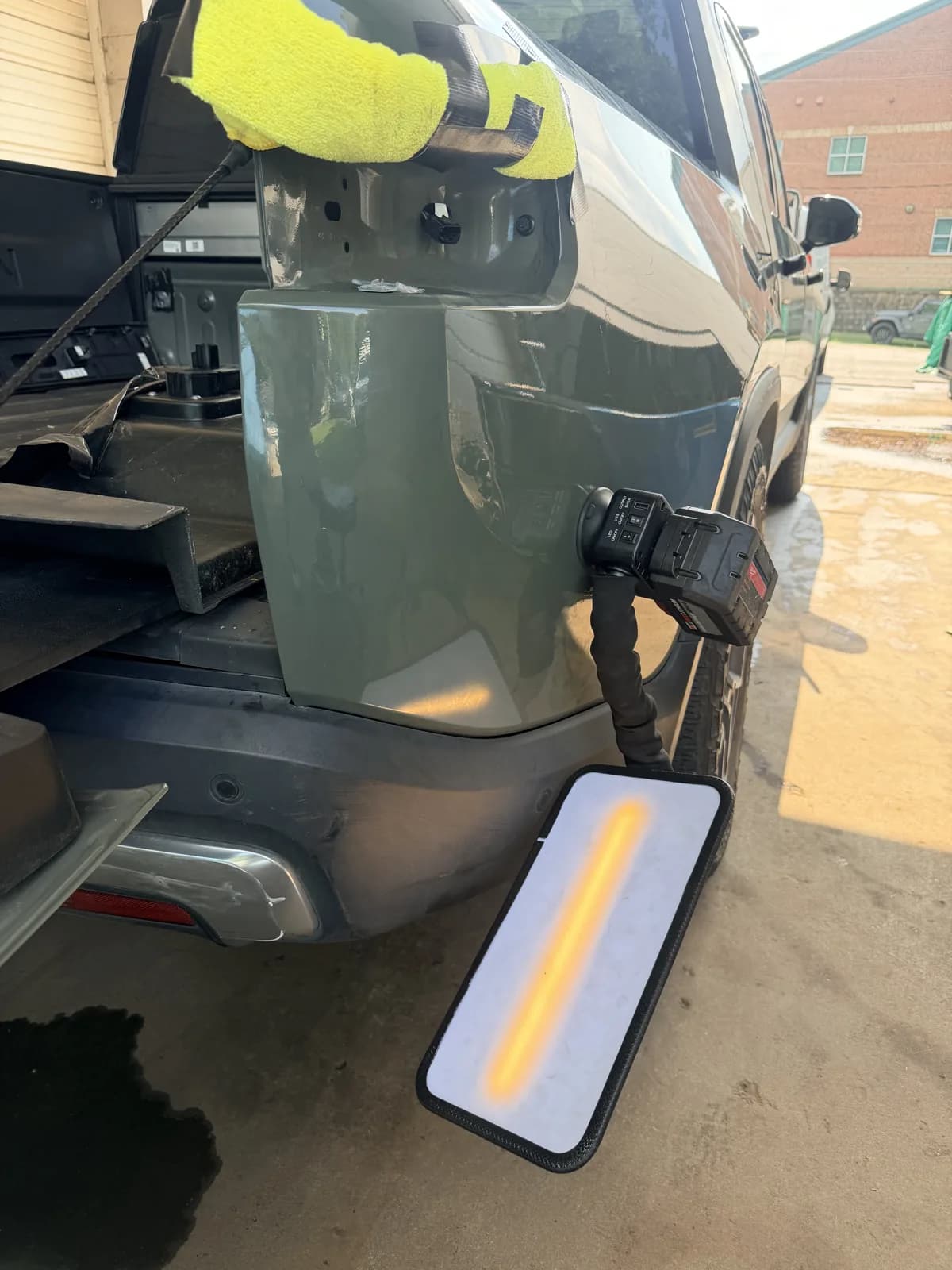
The lined light board is how a technician actually sees the dent. It exaggerates surface distortion so the true footprint of the damage — always larger than it looks in daylight — becomes readable.
Frequently Asked Questions
Is paintless dent repair a legitimate, permanent repair?
Yes. PDR is the industry-standard method used by dealerships, manufacturers, and insurers for qualifying dents. Because the metal itself is returned to shape, with nothing filled or covered, the repair is permanent.
Why is it called 'paintless' dent repair?
Because no painting is involved. The factory paint stays on the vehicle and stays intact, because the repair happens entirely in the metal beneath it.
Can I do PDR myself with a kit from Amazon?
DIY glue-pull kits can shrink a shallow dent, but they rarely finish one, and overpulling creates high spots that make professional correction harder and sometimes more expensive. For a vehicle you care about, a $125–$150 professional repair is usually the cheaper path in the end.
Does insurance cover paintless dent repair?
Comprehensive coverage typically pays for hail damage repair via PDR, and insurers often prefer it because it costs them less than body shop repair. See our insurance guide for how claims work.
Related Services
Keep Reading
A straight cost-benefit analysis of paintless dent repair from a technician with 25 years in the trade: what PDR costs versus what a dent costs you at resale, how it compares to body shop repair and to simply living with the damage, and the specific situations where we'll tell you not to spend the money.
A transparent breakdown of how paintless dent repair is priced, written by the technician who sets the prices. Why access and leverage behind the panel matter more than dent size, plus depth, position, aluminum versus steel, creases versus round dents, multi-dent work, how hail pricing runs through insurance, and why a photo is enough for an accurate quote.
Paintless dent repair and traditional body shop repair aren't competitors so much as tools for different jobs. This guide gives you the decision framework a 25-year PDR technician actually uses: one look at the paint answers most of the question, and cost, time, and resale value settle the rest.
Aluminum body panels dent differently, resist differently, and forgive less than steel — which is why many PDR technicians simply turn the work away. Here's how aluminum actually behaves, which vehicles use it, and what a proper aluminum repair requires.
Got a ding? Give me a ring.
Text a photo of your dent to 704-713-4663 for a free estimate — usually within minutes during business hours.
Rated 4.9 out of 5 across 103 Google reviews · Since 2001 · Shop in Mint Hill · Mobile across Charlotte